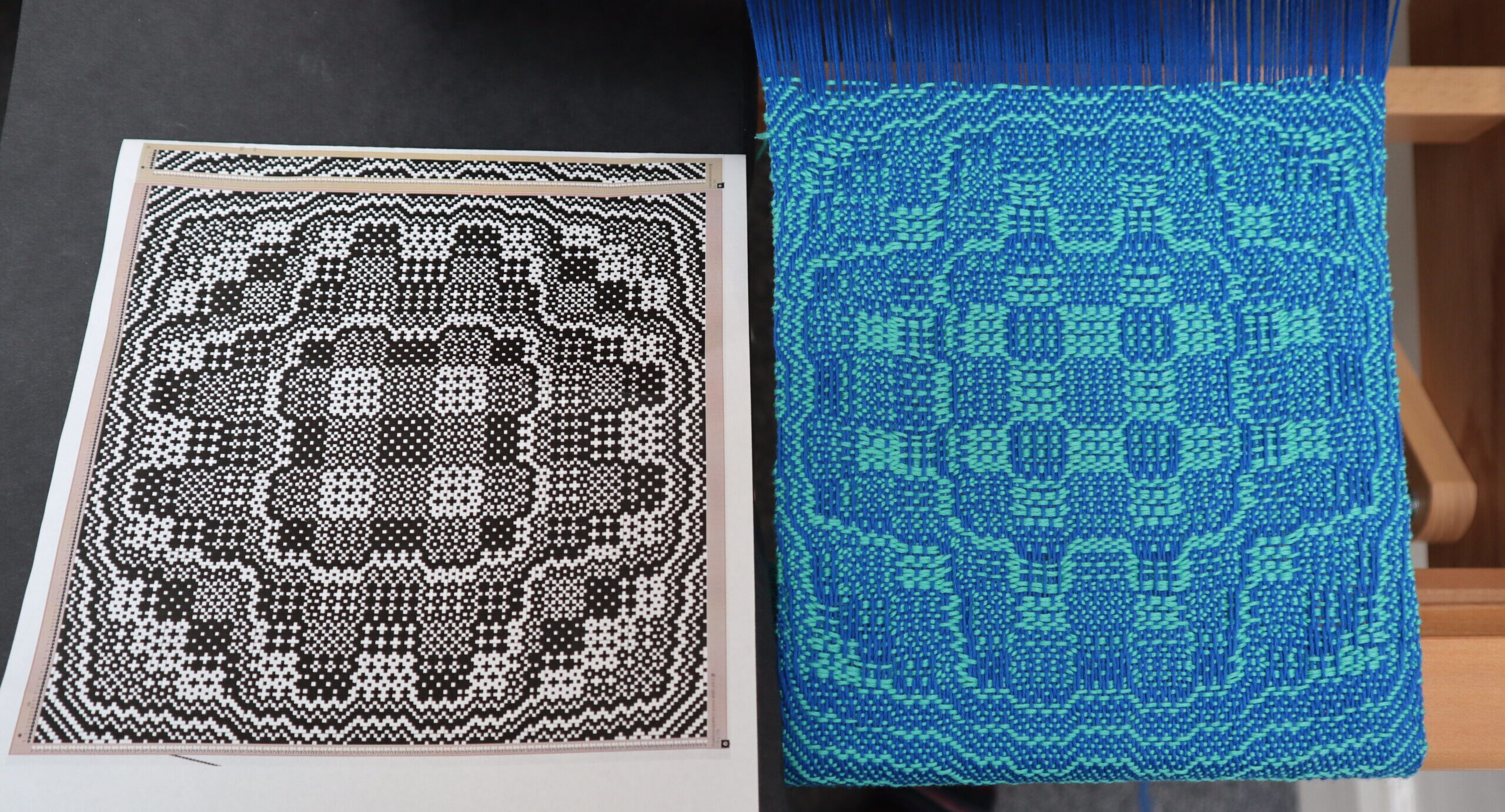
Lately I’ve been exploring 8-shaft weaving trying some things inspired by Laura Devendorf, focussing on ‘crackle weave’ using the AdaCAD software, embracing failure on the loom, eventually managing to thread a pretty cosmic crackle weave pattern I’d designed in AdaCAD.
I had to wait over the weekend before getting back to the loom to actually weave it, but here it is !
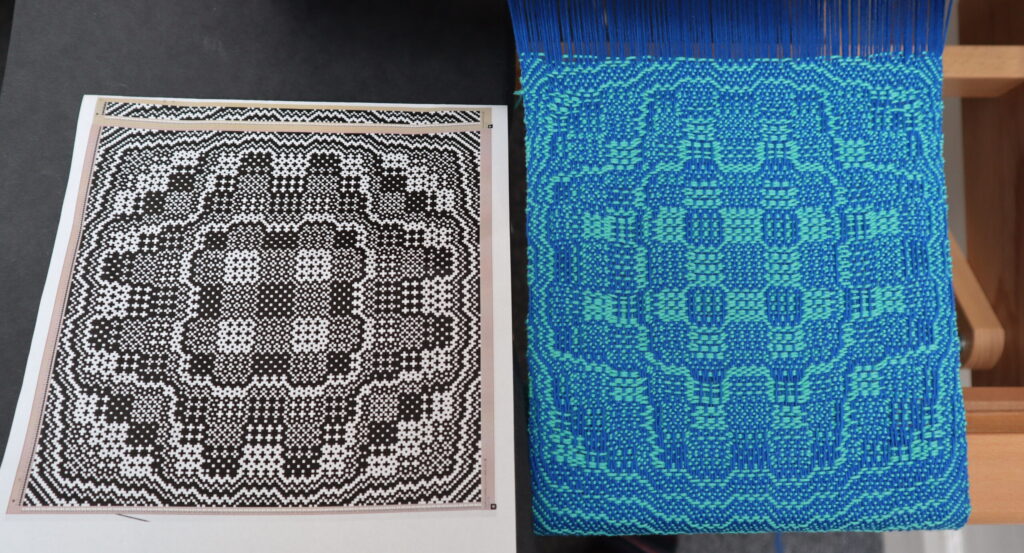
At first, it looks like an accurate rendering of the draft pattern (shown on the left) in woven form (on the right). But the longer you look at it, the stranger it seems. The draft shows a black cell or ‘pixel’ wherever a (dark blue) vertical ‘warp’ thread goes over a (light peppermint green) horizontal ‘weft’ thread. So naively, you might think they should look more or less identical. When you look at the details, that’s very much not the case.
In places it’s hard to orient myself when comparing the draft and weave; the first sign that something strange is going on is that lighter areas in the draft are sometimes also lighter in the weave, but sometimes darker. In several places it seems like the pattern in the draft does resemble the outcome in the weave, but then I realise that I’m comparing different areas. For example the most central ‘patch’ resembles the draft for the patches immediately above, below and to its sides.
‘Floats’ happen in weaving when there is a run of ‘warp up’ black or ‘warp down’ white pixels in either the horizontal or vertical direction. However, have a look at the patches on each diagonal around the centre patch. There are no consecutive runs of white or black longer than three in either direction, but when you look at the weave, there are several long floating warps proudly lying over the top of this section, which otherwise looks a bit like plain weave (i.e., the simplest up/down interlacement) but with doubled wefts. Why are these floating threads not woven in? If we go up or down one, and across three patches from the centre, we find a patch where warp and weft aren’t woven at all, but are instead sitting on top of each other, but in four distinct layers. This is a clue – it seems that the ups and downs of the crackle weave motif has the capacity to separate the bindings into separate layers. This is a technique called double weave, which seems magical but is very well known to weavers.
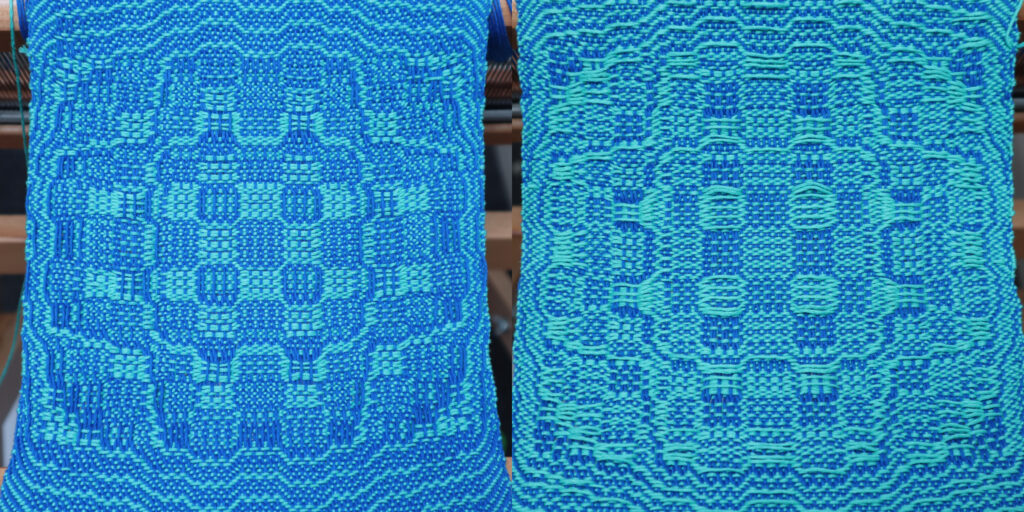
It’s a bit awkward to look at the other side of the fabric while it’s on the loom and under tension, you have to lie down on the floor and look up, or roll the textile off and flip it over. As a result I didn’t look at it at all while weaving. It looks very different, and definitely looks like the ‘back’ of a fabric, in terms of being messy. Comparing them closer though, it seems that the patterns are the same. The reason it looks different is that the blue warp has been under tension. It’s not under tension in the photo, but with the way I’ve passed the weft, the floats are more ‘relaxed’ and so move around more. While weaving I took care to pass the weft on a diagonal, to give additional yarn so that when you ‘beat in’ the weft, the additional travel over and under the warp doesn’t pull in the sides of the textile. Maybe with these floats I need to pass the weft straighter.
All this makes clear that despite all the two-dimensional binary grids involved in planning out weaves, a weaver’s pattern-thinking is three dimensional. Indeed we’re used to thinking of grids as two-dimensional, but they are really three dimensional – x, y and value, the three directly mapping to the three discrete dimensions of the physical binary interlacements of weaves. When woven, these interlacements don’t happen in discrete cells, but in the interdependent relationships between neighbouring and sometimes more distant threads.
I was hoping that the woven outcome would surprise me and I couldn’t be happier! It’s full of puzzles which I think with time will teach me a lot about how weaving bindings work in practice.
“Those who come with an aim to study this, they’ve not yet understood it. It has to come within.” Vankar Premjibhai (guide to the film)
@yaxu 🤩
Remote Reply
Original Comment URL
Your Profile
Why do I need to enter my profile?
This site is part of the ⁂ open social web, a network of interconnected social platforms (like Mastodon, Pixelfed, Friendica, and others). Unlike centralized social media, your account lives on a platform of your choice, and you can interact with people across different platforms.
By entering your profile, we can send you to your account where you can complete this action.