After a bit of time off from weaving after the PENELOPE project, it was great to visit Kristina Andersen, Pei-Ying Lin, Femke Vorselen and co in Wearable Senses lab in Eindhoven last year and explore hacking the TC/2 loom. This got me keen to get deeper into weaving, and I remembered Laura Devendorf enthusing about thinking in terms of shafts, and so we acquired a second hand 8-shaft table loom for the Alpaca project. Before I’d only really woven on looms where you control threads independently (in particular the TC/2, and my handmade live loom), which is often not how traditional weaving works. It might seem a bit strange to go from full control, to only lifting threads in eight groups of threads, but I suppose that’s how creativity works – finding constraints and playing with them.
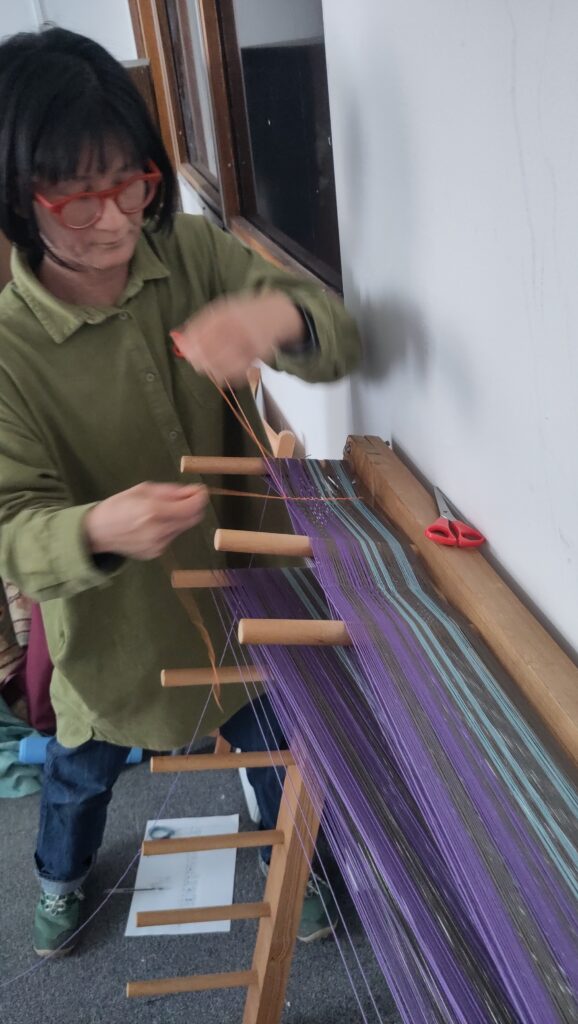
The loom arrived, as a wooden construction with a few special-use tools and other textile and cardboard items. Luckily my cool expert weaver friend Seiko Kinoshita was happy to get me started, showing me how to make a ‘warp’ (set of vertical threads), transfer it to the loom and thread it up – this took over a day but it probably would have taken me a week or so to figure it all out myself, with chaotic results. You might see a ‘cross’ in the threads in the photo, where threads alternate going under or over the pegs either side. This cross keeps threads in order, and if at any point the cross were to get lost that’s really game over. You also have to take care to maintain even tension throughout the warp – warping is a kind of artform in its own right! You’ll also see we decided to have a striped warp, alternating through colours in groups with some symmetry.
For more info about setting up a table loom, you could check on Dave’s tutorial that he made during our last-but-one “weaving codes, coding weaves” project.
When choosing a loom, I assumed a “table loom” was one that you placed on a table, and a “floor loom” is a larger one that you placed on a floor. This isn’t the core difference though — a floor loom is one which is operated with foot pedals, known as “treddles”. This actually changes the logic of the loom, because treddles are often tied to more than one shaft — this allows you to drastically simplify the patterns of movement needed to weave a complex pattern. The pattern in which you tie treddles to shafts is known as the ‘tie-up’. I’m not completely sure why table looms can’t have more than one shaft tied to each hand-operated lever, but it might just be down to it being too heavy.. After all, weaving operations have to be ergonomically tuned to the body, because you have to perform them repeatedly, thousands of times over many hours in order to produce cloth. It’s interesting how these decisions around the binary logic of the loom is grounded in the body in this way.
Seiko and I initially threaded the loom with a direct warping – with the first warp thread attached to the first shaft, the second to the second shaft and so on, wrapping round so the ninth thread is attached to the first. This means that you have full control over the warp threads, but also that the pattern must repeat every eighth warp. So before I started to weave I decided to change it to a ‘point threading’. This starts off the same – threaded to shafts 1, 2, 3, 4, 5, 6, 7, but then continues back 8, 7, 6, 5, 4, 3, 2. Accordingly, the pattern repeats every fourteen warp threads. What you gain in the width of the repeat, you loose in control – the first 7 threads are always the mirror image of the second 7 threads. If you like symmetry, then this is a win! But here you begin to understand why there is so much symmetry in weaving – not only does it look great, but it is also a consequence of the logic of the loom.
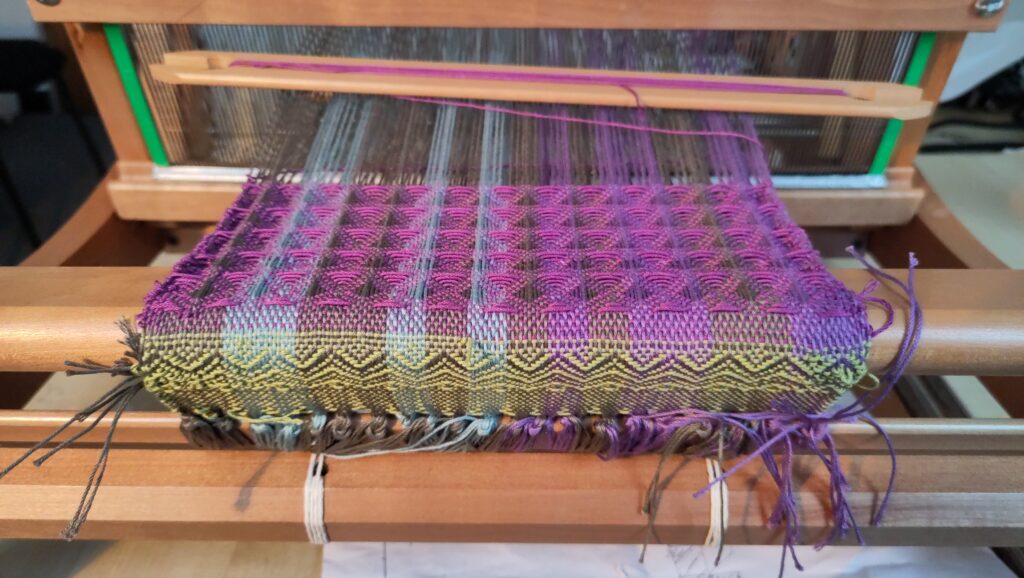
Above you can see the patterns I began with – first a pattern of chevrons, each 14 threads wide, which is basically a direct transfer of the threading to the cloth – I was simply raising one shaft in turn for each horizontal ‘weft’ thread. Then I tried a ‘waffle’, a simple yet fascinating pattern that creates this (at first) surprisingly very three dimensional structure from the otherwise two-dimensional pattern of shafts and lifts. This is often seen in tea towels.
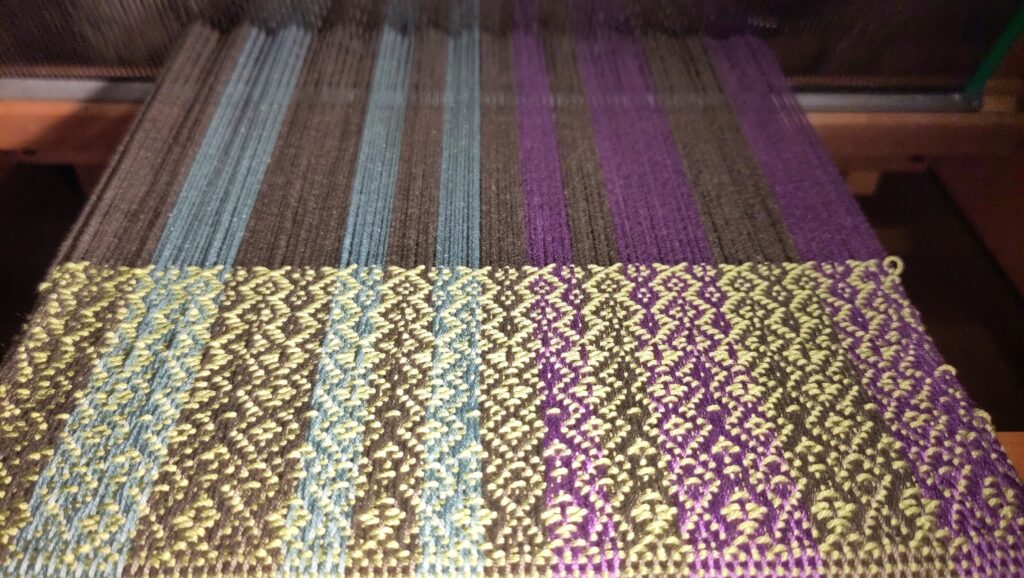
I was particularly happy with the above pattern, which has a long weft repeat because the ‘lift plan’ advances slowly in a sort of zig-zag pattern across the shaft levers.
As I was just getting into all this, I had to say goodbye to the loom for a while, for a trip back to Eindhoven to visit Kristina, Pei and Femke again, along with a newer research student Helen Milne in the Wearable Senses lab. We wanted to explore ‘multi-user weaving’, but of course shaft looms also entered the agenda. They have a nice range of looms in their collection, including table looms but our focus was still the computer-controlled TC/2, because we wanted to continue exploring the potential for live interaction through digital weaving. What we ended up doing though is making a shaft loom simulation for the TC/2.
The interface is shown below, and will be familiar to any weaver — the threading is shown across the top, the ‘tie up’ in the top left, the ‘treadling’ in the left, and the resulting ‘draw down’ in the centre. The draw down could be seen as representing what the fabric will look like given a warp of one colour and a weft of another colour. This isn’t really true – it doesn’t account for the three dimensional behaviour of the resulting cloth, you might end up with a layered ‘double weave’ cloth, or a fabric that doesn’t hold together at all.
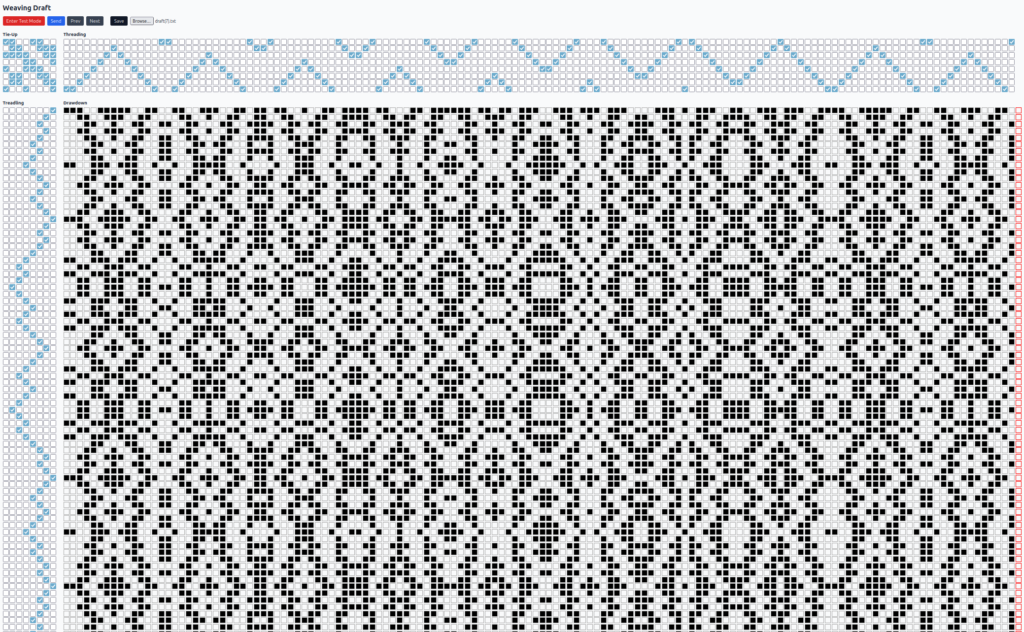
Because it has a ‘tie up’, this is a weaving draft for a floor loom with treadles. The same pattern would be possible on a table loom, but with a more fiddly ‘lift plan’ in the place of the treadling on the left – it would look similar but would have multiple lifts per weft to account for the lack of tie-up.
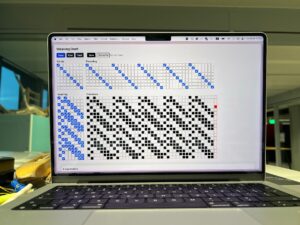
This interface is multi-user, so one person can be adjusting the threading, and another playing with the tie-up or treadling, while another is actually weaving the pattern at the TC/2. In practice this was a lot of fun! Having Kristina weave at speed, seeing a pattern emerge, and then making some adjustments while she was still weaving.. The adjustments would involve intermediary states that would get woven into the fabric, so that there would be glitches in the transitions between one pattern and another.
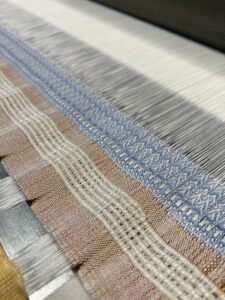
The TC/2 loom we were weaving on is an interesting loom designed for prototyping – there is a single foot switch for lifting the warp threads so that the next weft is passed, but then the human weaver who actually passes the weft. This means a wide range of yarns can be used for the weft that a machine wouldn’t be able to cope with, and adjustments can be made by hand. As mentioned in my previous blog, Pei and I ‘hacked’ the loom so that what warp threads are lifted can be controlled live by software, using the MQTT protocol.
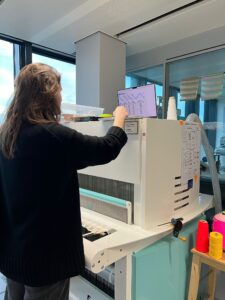
Part of the fun of all this came from the knowledge that changing the threading on a shaft loom might take hours, perhaps days or even weeks, but using this shaft-loom simulator to control the TC/2 meant it could be changed immediately. In practice working with this kind of weaving draft is highly generative, as Lea Albaugh explains, the binary logic of shaft looms is matrix multiplication; how the different interacting layers and resulting cloth interact is fascinating, taking a life time to explore.
We talked a lot about the relation between live coding with something like Strudel, and weaving, with Helen wanting to apply strudel-like patterning to weaving design. Helen has had a more traditional training in weaving, so well-used to loom-thinking, and seemed to take well to this shaft-loom interface to the TC/2, enjoying the live, physical design process. I’m looking forward to talking more about the possibilities of developing pattern languages for live weaving.
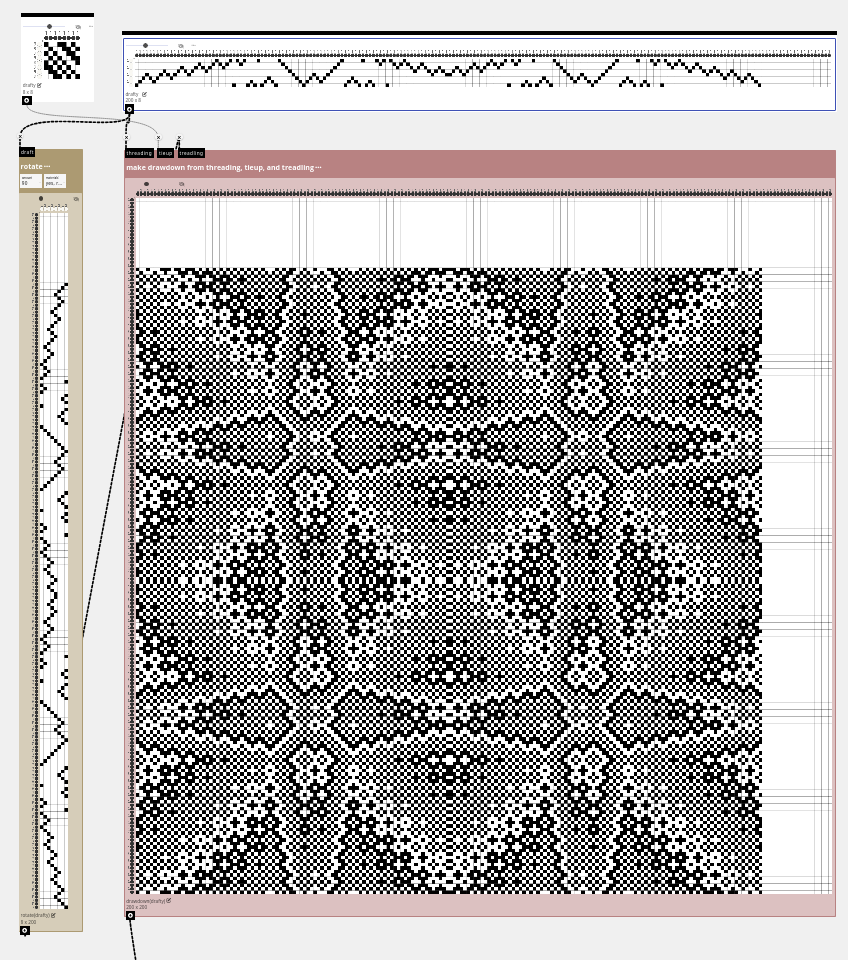
Back home, I was ready to change the threading on my table loom. I’d become interested in crackle weave, enjoying the computer generated crackle weave patterns created by the late computer scientist Ralph Griswold. Frustratingly, his papers refer to his weaving drafts available for free on handweaving.net, but have recently been paywalled, apparently under a restrictive license. Certainly a lot of work goes into this site, but this seems unethical, and it’s unclear on what basis the maintainer of the site is restricting its use. In any case, so far they sadly do not wish to discuss this, but I hope to spend some time on archiving these drafts openly and for posterity on archive.org.
Still, I managed to download a draft, and adjusted it for the number of threads in my current warp, using Laura Devendorf’s fantastic AdaCAD system. AdaCAD also made converting from a floor loom to table loom draft very easy. You can see my workings here if you’re curious!
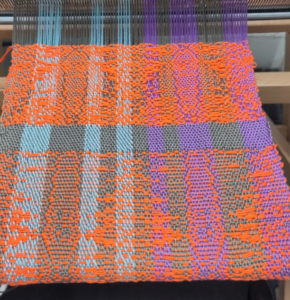
Re-threading the loom was difficult, and took over a day’s work. The threading for this crackle weave is much more complex than the previous point threading, with a lot of back and forth between heddles, and I made a couple of mistakes, but I managed to fix them in the end. I was also happy that despite the complex threading, due to the rules of crackle that Griswold was following in his draft, I was still able to do the simplest plain weave by switching between alternate shafts.
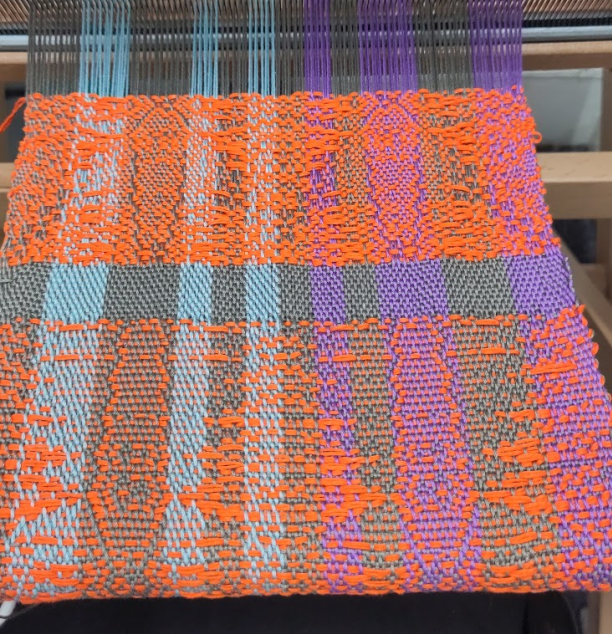
The pattern looked beautiful in AdaCAD, but with the striped warp, it was difficult to see the pattern. I tried a few things to make it clearer, including using ‘overshot’ technique as seen in the lower section of the above photo. This is where the pattern is woven using a thicker (or in this case doubled-up) weft yarn, interleaved with a plain weave. I realised though that this meant only ‘floats’ where a weft goes over more than one warp thread at a time were fully visible. I switched to weaving the pattern directly, but with a doubled up, bright orange yarn as seen in the top section, and am pretty happy with this so far!
Well this blog ended up much longer than expected, and there’s much more to say about how I worked with the crackle weave pattern – how mistakes became apparent, and how I worked around my poor memory by embodying the logic of the lift plan pattern. I’d better stop here for now, though!
@yaxu This is amazing work. They look so good.
Remote Reply
Original Comment URL
Your Profile
Why do I need to enter my profile?
This site is part of the ⁂ open social web, a network of interconnected social platforms (like Mastodon, Pixelfed, Friendica, and others). Unlike centralized social media, your account lives on a platform of your choice, and you can interact with people across different platforms.
By entering your profile, we can send you to your account where you can complete this action.
@yaxu Griswold! Icon programming language is fun (sort of, the actual implementation is a bit clunky). Lots of generators and co-routines.
Remote Reply
Original Comment URL
Your Profile
Why do I need to enter my profile?
This site is part of the ⁂ open social web, a network of interconnected social platforms (like Mastodon, Pixelfed, Friendica, and others). Unlike centralized social media, your account lives on a platform of your choice, and you can interact with people across different platforms.
By entering your profile, we can send you to your account where you can complete this action.
@yaxu that's so cool! thanks for posting about weaving 😁
Remote Reply
Original Comment URL
Your Profile
Why do I need to enter my profile?
This site is part of the ⁂ open social web, a network of interconnected social platforms (like Mastodon, Pixelfed, Friendica, and others). Unlike centralized social media, your account lives on a platform of your choice, and you can interact with people across different platforms.
By entering your profile, we can send you to your account where you can complete this action.