(Work in progress – comments welcome but I will probably edit this later!)
The AI summer has arrived, on blast for a long while now, and potential financial crashes/civilisational collapses aside, the next AI winter doesn’t seem to be around the corner.
But still, life goes on post-AI. In fact, just using the phrase “post-AI” gives us agency over what comes next, giving us permission to set our own narrative.
As I’ve said elsewhere, LLMs are like alcohol, as quick, easy solutions to problems. The wisdom and experience of recovering alcoholics tells us that “problem drinking” is a misnomer. Alcohol isn’t a problem, it’s a solution, to a complex of problems. These underlying problems need addressing in their own right to get to a healthier place. Only focussing on knock-on problems caused by alcohol (or LLMs) would probably not get us there.
So helpfully, considering LLM-use-as-a-solution points to a wide range of cultural problems that do need solving. For example in my area of live coding and creative technology, LLMs solve these problems:
- lack of support network – social isolation
- lack of documentation and working examples, centralised support forums dying
- lack of time, due e.g. to attention economy
- too much choice (e.g. javascript framework choice paralysis)
- software engineering community being toxic to a lot of people pre-AI (and the same or worse situation, post-AI!)
- cultural focus on extrinsic rather than intrinsic rewards
- ‘let me google that for you’ culture
- people forced to just try to get by without the privilege of making meaningful work
- poorly designed tools – programming language culture gatekept by limited range of people making poorly designing programming language environments for themselves
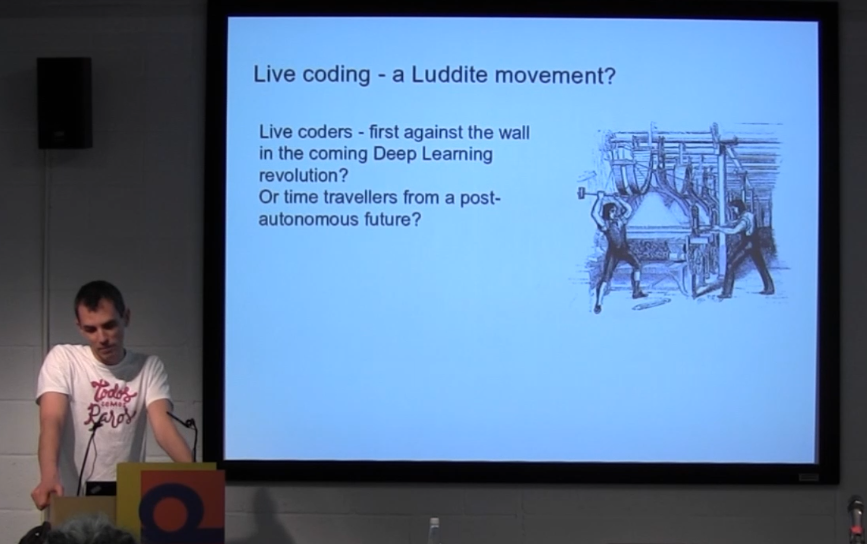
I think we should have been better prepared for this, really. For all the talk of radical disruption, the present LLM dystopia was extremely predictable. I picked up on this back in 2016, when researchers were starting to notice how old fashioned AI techniques were beginning to scale well with GPUs. I realised that if this replaced traditional computer programming, live coding would still survive, presenting some slightly garbled thoughts over a curious slide in this 2016 presentation:
This ended up as my 2017 article “lessons from the luddites“, recognising that while software engineering could be automated away, live coding in the creative arts could not be – it makes no sense to automate human expression. Therefore, live coding would become untethered from software engineering, and reimagined in the context of heritage crafts.
So we are now living in that post-AI world. Post-AI doesn’t mean AI is already finished and abandoned. It means that now it’s here, we can better see what life can be like in opposition to it, with all of its deep integration with lonely social media, its surveillance, censorship, hateful manipulation of public opinion, lazy sci-fi tropes, extraction of value at scale, centering of ketamine-addled billionaires, etc, etc. All of this points towards alternative ways of living and relating to each other, if we can only solve those underlying problems of social isolation etc, finding a way to create humane tech culture.
From my perspective this is about developing local, in-person communities, networked into international movements, developing alternative visions of technologies as meaningful, heritage craft practices. Finding ways, through these small networks, to share everything with everyone, in the face of AI scrapers. Treating AI techbro narratives as a distraction, and privileging the humane.